


Bison 1
Rethink Agriculture - heal the soil
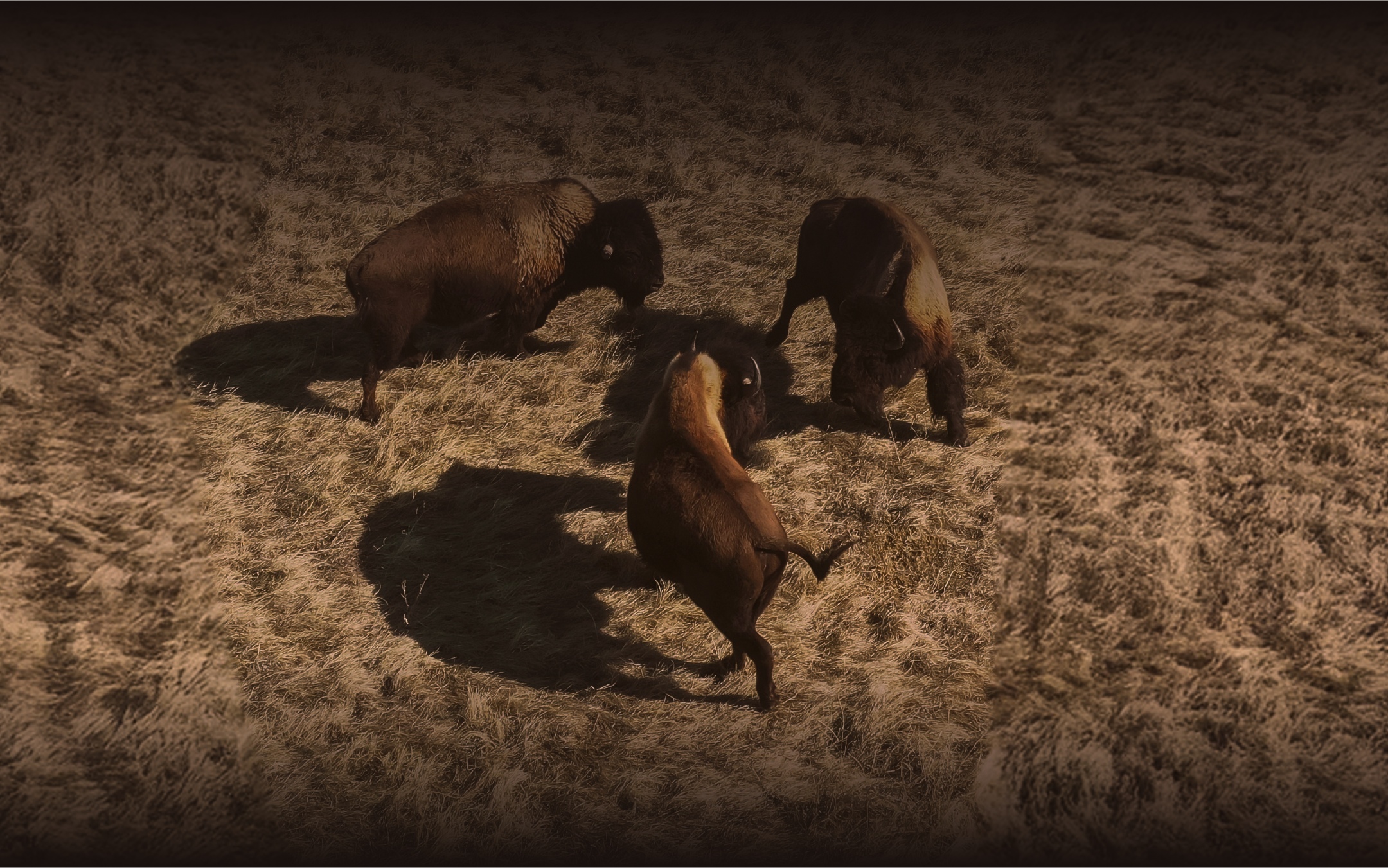
The Bison stands as a symbol of survival, power, and sacred relationship with the land. Revered by Native American tribes as a gift from the Earth, it provided food, shelter, and spiritual guidance. Its strength is not just physical. It embodies courage, willpower, and the wisdom to endure.
Bison are grounded beings, rooted in the North. They represent the union of the earthly and the unearthly, the primal force that connects sky and soil. Their presence is medicine. For the body, the people, and the planet.
In Indigenous traditions, the Bison is also linked to the Root Chakra, where survival begins. Its energy teaches us how to move through challenge, how to protect what matters, and how to walk the Earth with purpose.
HISTORY
Between thirty and sixty million Bison once roamed North America, from the Appalachians to the Rockies. For the Plains nations, the Bison was food, shelter, and clothing.
In the nineteenth century, the herds were destroyed on purpose. The United States government understood that the Plains nations lived by the Bison, and that removing the Bison would remove their independence. Destroying the herds became a means of forcing Native Americans off their homelands and onto reservations. Army leaders encouraged the killing, and hide hunters, carried west by the new railroads, carried it out by the millions. It stands as the largest deliberate destruction of a mammal species in modern history. By 1889, 541 Bison remained.
The return began with a handful of people who kept the last animals alive, among them Samuel Walking Coyote of the Pend d'Oreille and the Texas rancher Charles Goodnight. Yellowstone sheltered the only wild remnant. In 1905 the American Bison Society formed to rebuild the herds. Today more than half a million Bison live in North America, and tribal nations are returning Bison to their own lands.
Their numbers have returned, but their wildness has yet to. More than 90 percent of America's Bison are raised commercially, behind fences, as livestock. Only about 31,000 live as wild, conservation herds, and many of those carry traces of cattle genes from early crossbreeding. Ecologists describe the Bison as ecologically extinct: present on the land but absent from the role it once played across the prairie.
Yellowstone holds the one herd that has lived wild there since prehistoric times, and it is among the few free of cattle genes.
The Cave
Altamira, Cantabria, Spain
Painted roughly 15,000 years ago. Discovered in 1879, when eight year old María Sanz de Sautuola looked up and saw bison on the ceiling. It was the first painted cave ever found. Its main chamber holds 21 bison in red and black, and the painters used natural swells in the rock to give them form. A UNESCO World Heritage Site since 1985. Picasso is said to have regarded it as the summit of all art.
Lascaux, Dordogne, France
Painted roughly 17,000 years ago. Discovered in 1940 by four teenagers. Bison standamong the horses, aurochs and deer across its walls.
Tuc d'Audoubert, French Pyrenees
Modeled roughly 15,000 years ago. Discovered in 1912 by the three Bégouën brothers. Six hundred and fifty meters inside, two clay bison rest against a stone, their jaws traced by the sculptor's fingernail.
These artists painted the steppe bison, ancestor of the American and European bisonliving today.

The Buffalo Nation
To the Lakota, the bison is Tatanka. In the Black Hills, at a time when the people sought guidance, White Buffalo Calf Woman appeared bearing the sacred pipe. Carved on its bowl, the buffalo calf stands for all four legged beings of the earth. With this pipe, she taught, the people are bound to all their relatives. As she departed, she became a white buffalo calf, and great herds filled the plains.
19th‑century oil painting by George Catlin (1796–1872) part of Catlin’s extensive documentation of Indigenous life on the Great Plains.

The Grazer
The bison is a keystone species, an animal whose presence shapes an entire landscape. It grazes for roughly a quarter of its day and keeps moving, so the land rests and regrows behind the herd. Its dung feeds beetles that turn and enrich the soil. At Kansas's Konza Prairie, decades of research found that returning bison doubled native plant diversity, and the prairie they grazed held strong through drought.
The Carbon Keeper
In 2014, European bison returned to Romania's Țarcu Mountains after an absence of more than two centuries. A Yale study modeled the effect of the herd of 170: grazing evenly, recycling nutrients, spreading seed and pressing carbon into the soil, these bison help store carbon equal to taking at least 43,000 cars off American roads for a year.

Rethink Agriculture
The bison offers a blueprint: move, graze, rest, return. Scientists now design cattle grazing that follows the bison's ancient rhythm. Land worked in harmony with the wild pattern builds richer soil, greater biodiversity and lasting carbon. It is proof that what we choose to eat and what we choose to wear can change the world.

The Bison
The Earth Keeper
Symbol of strength, unity, and survival
Bison meet the storm head on
Honored as sacred provider and guide
Bison energy grounds and connects us to the Earth
Bison root us in the soil. The rich microbiome of the planet. Heal the soil. Heal the planet.
A teacher of how to endure and grow through adversity

The Number 1
Number of unity, leadership, and origin
Represents the pioneer spirit and the root of all potential
The most self-sufficient number, source of new beginnings
The breast plates
Originally worn as armor, made of Eagle bone
Brought both physical and spiritual protection
First used by the Comanche and adopted by many Plains tribes
A symbol of readiness, resilience, and sacred defense

Inner and outer rings
Symbol of the sacred medicine wheel and the 4 directions
The circle of life, seasons, and natural cycles
The number 10
Completion and transformation
1 is beginning, 0 is infinite potential
The All-Seeing
Shaman Eye
Vision of the medicine man
Sees both the spirit world and the physical plane
Broken Arrow
Represents making peace with yourself, others, and the planet
Nothing is ever gained by inflicting pain

Bison is the Earth keeper
Rethink Agriculture
Heal the soil
From Inspiration to Creation


what is your spirit totem?


Navajo peach
on the horizon

Mystical mushroom
on the horizon